Monday, November 21, 2011

Thanksgiving and Sukkot

What could be more Jewish than surviving great difficulties and thanking God by having a large feast? Thanksgiving and sukkot may be a lot more related than you think.  My family's cornucopia was always made with exactly the same harvest decorations that we used for decorating the sukkah, but that is only the beginning.

 Here are some websites with good comparisons of the two holidays, and good explanations of why Thanksgiving is, indeed, a Jewish holiday.

There is a strong thread which runs from the Israelite wilderness experience to that of the Pilgrims and the harsh years they endured as they strove to sink roots in this new land. Like the ancient Israelites of whom they read in the Bible, they were people of great faith who believed themselves to be sustained through God's great mercy and beneficence. That they should rejoice and give thanks at harvest time was as natural an impulse for the Pilgrims as it was for the ancient Israelites.


Rabbi Zalman Schachter-Shalomi has written a special Thanksgiving prayer that can supplement the Birkat HaMazon. The English reads: "In the days of the Pilgrims, the Puritans, when they arrived at these safe shores, suffered hunger and cold. They sang and prayed to the Rock of their Salvation. And You, standing by them, roused the caring of the Natives for them: who fed them, turkey and corn and other delights. "Thus saved You them from starvation, and they learned the ways of peace with the inhabitants of the land. Therefore, feeling grateful, they dedicated a day of Thanksgiving each year as a remembrance for future generations, feeding unfortunates feasts of thanks. Thus do we thank You for all the good in our lives, God of kindness, Lord of Peace; thus do we thank You."
According to Rabbi Susan Grossman, the popularity of Thanksgiving among Jewish families should be of no suprise. In her Beliefnet.com blogpost, “Thanksgiving Is a Very Jewish Holiday,” Grossman says, “After Passover and Hanukkah, Thanksgiving is perhaps the most observed by American Jews.” Grossman points to the holiday’s intersection with core Jewish values as the reason for its popularity. “Thanksgiving, as in giving thanks, is a very Jewish thing to do,” she says. “According to tradition, Jews are to give thanks 100 times each day. We are to give thanks before we eat, for having food, and after we eat, for having been able to have food.” Another reason, she explains, is our Jewish history of immigration. “America has been good to the Jews,” she writes. “We have always lived here in relative safety. Our rights as a minority religion are protected by law and the Constitution’s Bill of Rights.”


And this is a wonderful new tradition you might want to consider: a short Thanksgiving Seder in which we bring the story of Thanksgiving right to the dinner table, just as we do on Passover, and in which we add specifically Jewish blessings to a meal of Thanksgiving.

Wednesday, November 16, 2011

Tying Tzitzit


My 7th graders at the reform temple got a chance to learn how to tie tzitzit today.  We were just practicing, so we didn't have kosher string, and we used brown for the shamash rather than techelet (blue) or white, but everything else was authentic.  They tied onto a key ring, and if this class is at all like the class I had three years ago, the key rings will stay on their backpacks through the next few years.

They can all sing the "vayomer" paragraph of shma, and kiss tzitzit at each mention, and they can answer these questions:


 ציצית
1)          What are tzitzit?
2)          What is the tzitzit commandment?
3)          Where in Torah does it come from?
4)          How is the tzitzit commandment different from some of the commandments God gave through Moses?
5)          What do tzitzit remind us of?
6)          What’s the name of the prayer that includes tzitzit? 
7)          Which paragraph is this?
8)          Why did the reform movement stop saying this prayer for 100+ years?
9)          Why was it added back in?
10)    Which section of the service includes this prayer?
11)    What color did tzitzit used to have?
12)    Why did they stop using the color?
13)    How many times do we kiss the tzitzit during the prayer?
14)    What is the name of the longest string we use when wrapping and then tying the knots for the tzitzit?
15)    Where else have you heard that word?
16)    In class, did we learn the Sephardic or Ashkenazi way to wrap tzitzit? Why?
17)    What do you like about tzitzit?  Are they a reminder?  Do you think you’ll like wearing them when you’re an adult? 

Tuesday, November 8, 2011

A Typical Day in Hebrew School

Our first verse of Torah happens to be THE first verse of Torah.  Some of us can read the Hebrew, but some just now how to read the English and illustrate the first week of creation.


We have our first spelling word.  We know the letters and the vowels, we know where to put the dots, and we know how to draw three things that go with "Shabbat."


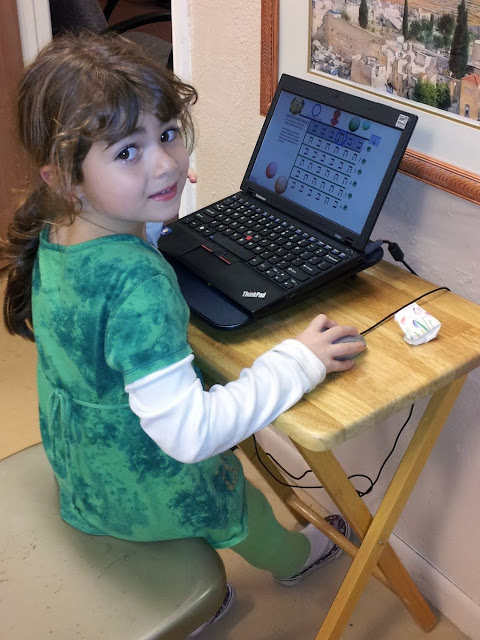
We take turns practicing our letters, vowels and words on the computer.


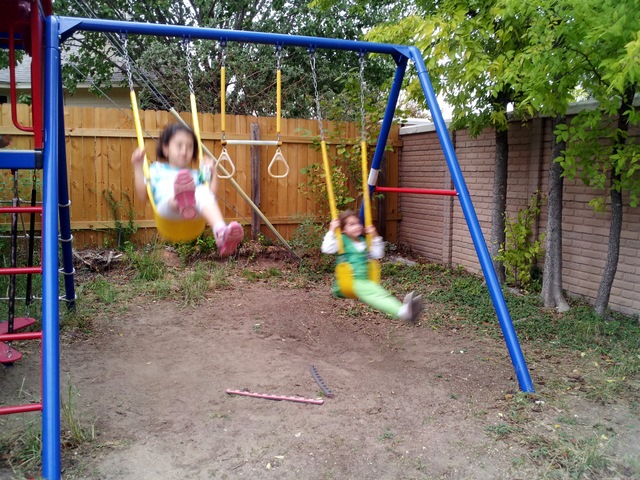
After so much learning, we need a break!  A healthy snack and 10 minutes on the playground.


Monday, November 7, 2011

Sh'ma in Papua, New Guinea

I am Jewish.  Big surprise, eh?  OK, maybe not, but I feel the need to specify that before I tell you that you should watch this video of non-Jews in Papua, New Guinea singing שְׁמַע יִשְׂרָאֵל with as much kavannah as any Jewish worshippers I've ever prayed with.  Fewer clothes, but equal intensity.

So, via The Schmooze:

Video: Hebrew Prayer in Papua New Guinea

By Renee Ghert-Zand

At this point, the Shmooze is used to seeing videos posted on social networking sites of cute little Hebrew school or Jewish day school children reciting the Sh’ma. But this Sh’ma video spotted and published by Israel National News the other day is quite unusual. You will not see little ones dressed in blue and white or their Shabbat best, but rather people of Papua New Guinea in their native dress reciting — in Hebrew — the central creed of Judaism.
It turns out these are Christians who have been taught, presumably by missionaries, to recite the Sh’ma to demonstrate their love and respect for Christianity’s Jewish roots. The video appears to have been shot by Yakov Damkani, a Messianic Jew.
Watch Papua New Guineans Recite the Sh’ma:


Read more: http://blogs.forward.com/the-shmooze/145812/#ixzz1d5Sv05oS

h/t Dorron Katzin 

Sunday, November 6, 2011

Lech Lecha Observations by my students

We read this Lech Lecha book yesterday in our children's service and talked about the parsha.  A first grader observed, "Isn't it good that Hashem picked a night when it wasn't cloudy? It would be so sad if Avram went out to count the stars and he couldn't see them."


Her classmate replied, "Yeah. And it's good Avram didn't need glasses cause they hadn't been created yet.  What if he went outside and the whole sky was blurry and he couldn't see the stars."


Third classmate: "Yeah, silly.  But if Avram needed glasses and didn't have them, maybe Hashem would just make him count something he could see."


OK, whose rabbi gave a more thought-provoking dvar?  Or asked more inspiring questions?