Showing posts with label whole class. Show all posts

Monday, May 14, 2012

I teach the smartest students on earth, part 687


Each year, no matter whether I teach for one school or three, tutor teens or elementary school children, I always end up with some of the most insightful and spiritual Torah students on the planet.  A few recent examples ....


I am currently teaching four official, set classes in three different locations, one synagogue, one synagogue classroom, and a library conference room.  I also tutor five students in their own homes and three in my home. I was recently doing a unit on Goldilocks has Shabbat dinner with the Three Bears. (Dinner and brachot come after she breaks the chairs, but before she eats everyone's challah.)  Bayit בַּיִת (house) is one of the central vocabulary words, and by the end of the story the phrase for synagogue/temple/shul is introduced -- בֵית הַכְּנֶסֶת Beit HaKnesset.  I was working with a young student from one synagogue and pointed out to him that the word Beit has the same meaning and same root as Bayit, and I told him about the symbolism of a synagogue as house, and also explained that my Monday/Shabbat synagogues actually IS half a house.  We looked at it on Google Maps, and I showed him how the cantor and his seven-year-old daughter live on one side of the two-family house, with the garden and playground on their side, and that the other side was the synagogue.  I showed him a few photos of the sanctuary and my classroom and he said that he wished he could live where the Cantor and his daughter live --- a house less than 1/3 the size of his current home.  I asked why, and he replied that he would love to visit the Torah every day and say prayers right near the Torah.   Needless to say, my heart melted.


Impressed with an eight year old?  I sure was.  But listen to what a five-year-old said today.  This little girl attends school during the day at a small school run by the local Chabad rebbetzin, but also comes to the after-school combined Hebrew School/Religious School that I run on Mondays.  Her sister attends, her friends attend, there's considerable crossover between the lessons on Monday and Shabbat morning children's services, so she decided one day that she should come.  And so she does.  Often she is the most knowledgeable in the class about upcoming holidays and the parsha, but today she surprised me with an observation that would be sophisticated coming from a child twice her age.  We were discussing Shavuot and the giving of Torah, and one of the kids talked about Moshe smashing the tablets.  Another student knew that it was because he was angry, but no one knew what he was angry about.  I explained the incident of the golden calf and then we returned to the issue of Moshe smashing the tablets.  The my youngest Monday student then piped up with the most amazing observation.  "But Hashem's name was on the tablet and Moshe did a bad thing by breaking something with Hashem's real name and throwing it on the ground."  I've never thought of it that way.  Have you? 

I learn so much from my students!

Tuesday, February 7, 2012

Tu B'Shvat at Beth El

We had a tu b'shvat seder during religious school at Congregation Beth El and planted in our brand new synagogue herb garden.


More photos here: https://picasaweb.google.com/MorahBetsy/BethElTuBShvatKids

Monday, November 21, 2011

Thanksgiving and Sukkot

What could be more Jewish than surviving great difficulties and thanking God by having a large feast? Thanksgiving and sukkot may be a lot more related than you think.  My family's cornucopia was always made with exactly the same harvest decorations that we used for decorating the sukkah, but that is only the beginning.

 Here are some websites with good comparisons of the two holidays, and good explanations of why Thanksgiving is, indeed, a Jewish holiday.

There is a strong thread which runs from the Israelite wilderness experience to that of the Pilgrims and the harsh years they endured as they strove to sink roots in this new land. Like the ancient Israelites of whom they read in the Bible, they were people of great faith who believed themselves to be sustained through God's great mercy and beneficence. That they should rejoice and give thanks at harvest time was as natural an impulse for the Pilgrims as it was for the ancient Israelites.


Rabbi Zalman Schachter-Shalomi has written a special Thanksgiving prayer that can supplement the Birkat HaMazon. The English reads: "In the days of the Pilgrims, the Puritans, when they arrived at these safe shores, suffered hunger and cold. They sang and prayed to the Rock of their Salvation. And You, standing by them, roused the caring of the Natives for them: who fed them, turkey and corn and other delights. "Thus saved You them from starvation, and they learned the ways of peace with the inhabitants of the land. Therefore, feeling grateful, they dedicated a day of Thanksgiving each year as a remembrance for future generations, feeding unfortunates feasts of thanks. Thus do we thank You for all the good in our lives, God of kindness, Lord of Peace; thus do we thank You."
According to Rabbi Susan Grossman, the popularity of Thanksgiving among Jewish families should be of no suprise. In her Beliefnet.com blogpost, “Thanksgiving Is a Very Jewish Holiday,” Grossman says, “After Passover and Hanukkah, Thanksgiving is perhaps the most observed by American Jews.” Grossman points to the holiday’s intersection with core Jewish values as the reason for its popularity. “Thanksgiving, as in giving thanks, is a very Jewish thing to do,” she says. “According to tradition, Jews are to give thanks 100 times each day. We are to give thanks before we eat, for having food, and after we eat, for having been able to have food.” Another reason, she explains, is our Jewish history of immigration. “America has been good to the Jews,” she writes. “We have always lived here in relative safety. Our rights as a minority religion are protected by law and the Constitution’s Bill of Rights.”


And this is a wonderful new tradition you might want to consider: a short Thanksgiving Seder in which we bring the story of Thanksgiving right to the dinner table, just as we do on Passover, and in which we add specifically Jewish blessings to a meal of Thanksgiving.

Wednesday, November 16, 2011

Tying Tzitzit


My 7th graders at the reform temple got a chance to learn how to tie tzitzit today.  We were just practicing, so we didn't have kosher string, and we used brown for the shamash rather than techelet (blue) or white, but everything else was authentic.  They tied onto a key ring, and if this class is at all like the class I had three years ago, the key rings will stay on their backpacks through the next few years.

They can all sing the "vayomer" paragraph of shma, and kiss tzitzit at each mention, and they can answer these questions:


 ציצית
1)          What are tzitzit?
2)          What is the tzitzit commandment?
3)          Where in Torah does it come from?
4)          How is the tzitzit commandment different from some of the commandments God gave through Moses?
5)          What do tzitzit remind us of?
6)          What’s the name of the prayer that includes tzitzit? 
7)          Which paragraph is this?
8)          Why did the reform movement stop saying this prayer for 100+ years?
9)          Why was it added back in?
10)    Which section of the service includes this prayer?
11)    What color did tzitzit used to have?
12)    Why did they stop using the color?
13)    How many times do we kiss the tzitzit during the prayer?
14)    What is the name of the longest string we use when wrapping and then tying the knots for the tzitzit?
15)    Where else have you heard that word?
16)    In class, did we learn the Sephardic or Ashkenazi way to wrap tzitzit? Why?
17)    What do you like about tzitzit?  Are they a reminder?  Do you think you’ll like wearing them when you’re an adult? 

Tuesday, November 8, 2011

A Typical Day in Hebrew School

Our first verse of Torah happens to be THE first verse of Torah.  Some of us can read the Hebrew, but some just now how to read the English and illustrate the first week of creation.


We have our first spelling word.  We know the letters and the vowels, we know where to put the dots, and we know how to draw three things that go with "Shabbat."


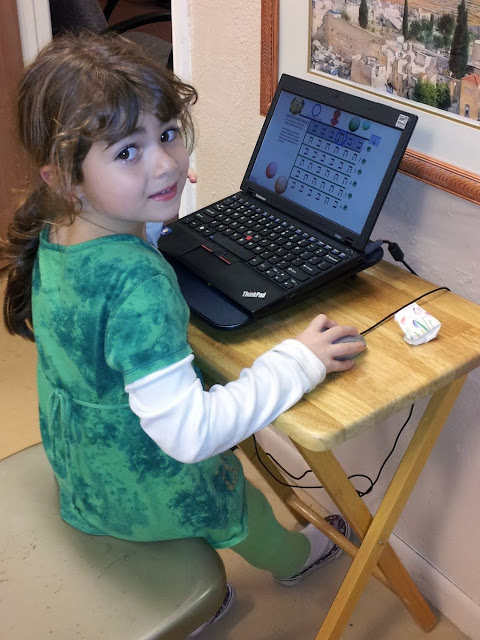
We take turns practicing our letters, vowels and words on the computer.


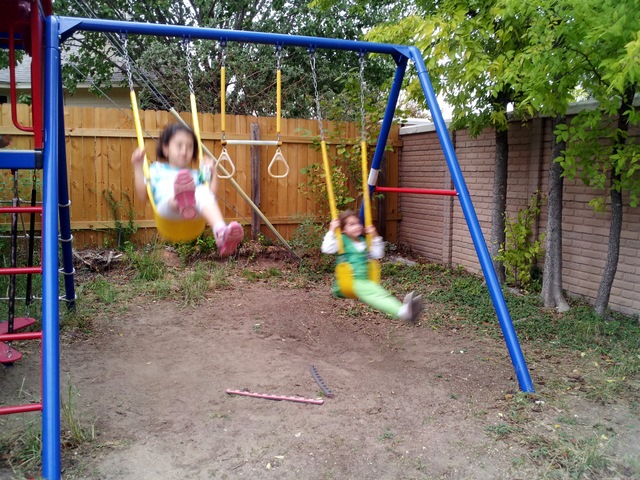
After so much learning, we need a break!  A healthy snack and 10 minutes on the playground.


Monday, October 31, 2011

Definition of the word DISDAIN

I had a chat with my religious school kiddos today (conservative synagogue,six conservative girls and two orthodox girls) about the difference between Jewish holidays, secular holidays, and holidays from other religions.  And now I know the definition of "disdain".

1dis·dain

 noun \dis-ˈdān\   The tone of voice with which a Jewish 3rd grader explains to other Jewish kids how Christian kids get presents on Christmas, and they think they come from some fat guy named Santa Claus!
Who even knew that an eight-year-old could roll her eyes!


Sunday, October 16, 2011

Simchat Torah Handouts


Lots of handouts and activities here.  Hope everyone has a WONDERFUL Simchat Torah!

Getting ready for Simchat Torah!

They were too busy drawing and writing about their favorite Torah stories to pause long enough to spell the word תּוֹרָה‎‎, but they did manage to come up with the correct spelling and hold it up almost long enough for me to get a photo. 


Monday, October 3, 2011

Jonah Lessons!


Powerpoint presentation is here:


And then our crafts project is here:

For the craft project:
What's Jonah doing in there?  Draw a picture to put inside.  
On the back of the whale, have Jonah explain what happened in his life this week.


Monday, September 26, 2011

The Sweet Year We Want to Have

Today, my religious school students planned, discussed, wrote, and drew all the sweet things they want to bring with them into the new year.  The things they want to learn, the things they want to improve, the way they want to be.  Here's a sample, from students from kindergarten to third grade:


  • Leren to climb a Tree
  • Learn to write Hebrew
  • Learning to read
  • I want to start being more helpful.
  • Beter at blowing the shofar
  • Life.
  • happy, nice, love
  • Being nice to my sister,
  • I wan to blow the shofar.
  • Beter at cleaning my room.

From Blogger Pictures
Next week, when we take a tashlich field trip to the closest pond, we will talk more about all the angers, mistakes and mean things from the past year that we are ready to throw away.

Wednesday, September 21, 2011

I Danced!!!!!!!!!!!!!

image via http://www.grapejews.com/
For those who don't know, I have been disabled to one degree or another for the past twelve years.  I've used canes daily the entire time, but have also spent great amounts of time in both a manual and a power wheelchair. I had surgery to repair 3 levels of my spine this past May, and have been walking and swimming well since June.  After surgery, I had to come up with a 3 month goal and a 6 month goal.  My 3 month goal was to dance.

I still use canes on stairs or when I am carrying my laptop or anything else of significant weight, but I have also been moving better and was given permission this month to exercise and stretch in new directions, and permission to dance.  Not wheelchair dancing. Not sitting and clapping while everyone else moved.  Not even dancing with crutches.  Dancing.

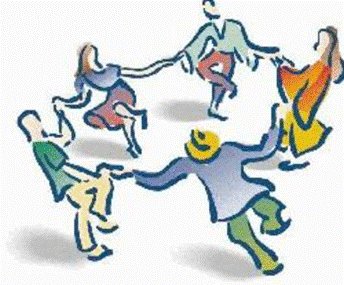
Today I danced!  I taught my 7th graders at Beth Shalom how to dance the Hora for all the Bar & Bat Mitzvah parties, and I danced with them!  Before we started, I honestly didn't know how well it would go, or even if I would fall.  I didn't fall.  I danced and danced and taught them how to celebrate in a Jewish way.  I danced.

Huge, huge thanks to God and my doctors.  My gratitude is overwhelmed only by my joy.

I am crying such tears of joy as I write this.  Honestly, you have no idea how much I have missed dancing.

I am only sorry that I didn't ask someone to photograph or take video or the event, but that just means I have to do it again.